Author name: Aman

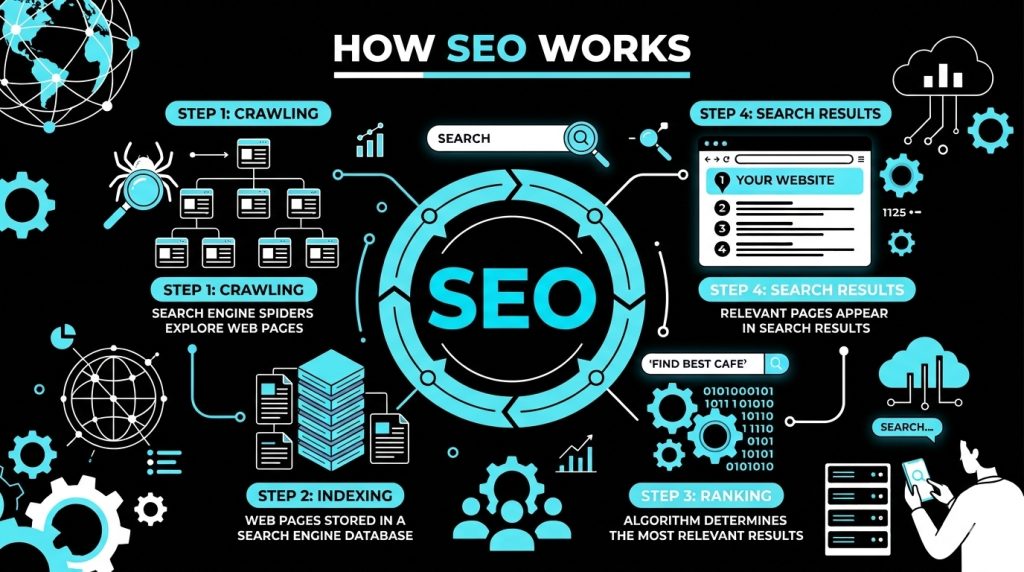
An educational infographic titled "HOW SEO WORKS" outlining a four-step process—Crawling, Indexing, Ranking, and Search Results—illustrated with cyan text, icons, and diagrams on a black background.
SEO

How SEO Works

Have you ever searched for something on Google, such as the best restaurant near you, digital marketing services, or tips to grow your business online? Within seconds, Google shows thousands of results related to your search. But have you ever wondered why some websites appear at the top while others remain on the second, third, or even tenth page? The answer is SEO, which stands for Search Engine Optimization. SEO helps websites improve their visibility on search engines like Google. When a website follows good SEO practices, search engines can better understand its content and determine when it may be useful to people searching for related information, products, or services. For businesses, SEO is an important way to reach potential customers, attract relevant website visitors, build trust, and grow online. Whether you run a small local business, an online store, or a digital marketing agency, understanding how SEO works can help you build a stronger online presence. In this guide, we will explain how SEO works, how Google ranks websites, the main types of SEO, and the steps you can take to improve your website’s search visibility. What Is SEO? SEO, or Search Engine Optimization, is the process of improving a website so that it can appear more prominently in organic search results. Organic search results are unpaid listings that appear when someone searches for information on a search engine. Unlike paid advertisements, you do not pay Google for every click you receive from organic results. The main goal of SEO is to help search engines understand your website and help users find relevant, useful content. For example, imagine you own a dental clinic in Delhi. When someone searches for “best dentist in Delhi,” you want your clinic’s website to appear among the relevant search results. SEO can help improve your chances of reaching people who are actively looking for dental services. SEO involves several activities, including: Finding relevant keywords that people search for. Creating helpful and informative website content. Improving website speed and mobile usability. Optimizing page titles, headings, URLs, and images. Building your website’s reputation through relevant links and mentions. Improving local search visibility when your business serves a particular area. Checking website performance and making improvements over time. SEO is not about tricking search engines. It is about creating a website that is useful for people and easy for search engines to discover, understand, and access. How Does SEO Work? SEO works through a combination of activities that help search engines discover your website, understand its content, and decide which pages are most relevant to a user’s search. Google generally uses three important stages: crawling, indexing, and serving search results. SEO can influence how effectively your pages perform throughout this process, although no SEO technique guarantees a particular ranking. Let’s understand each stage in simple language. 1. Crawling: Discovering Your Website Crawling is the process through which search engines discover and access web pages. Search engines use automated programs called crawlers or bots to explore websites. Google’s primary web crawler is known as Googlebot. Googlebot can discover pages through links from other pages, sitemaps, and previously known URLs. It then attempts to access those pages and understand their content. For example, imagine you publish a blog titled “Benefits of Digital Marketing for Small Businesses.” If Google discovers the URL and can access the page, its crawler may visit it to examine the content. To make crawling easier, you should: Create a clear website structure. Link important pages together. Submit an XML sitemap through Google Search Console. Avoid accidentally blocking important pages in robots.txt. Fix broken internal links. Make sure important content is accessible to search engine crawlers. If Google cannot discover or access an important page, that page may struggle to appear in search results. 2. Indexing: Understanding and Storing Your Content After crawling a page, Google may analyze its content and decide whether to include it in its search index. Indexing is similar to organizing information in a huge digital library. Google processes information such as page text, images, titles, and other available signals to understand what a page is about. For example, if your page explains “What Is SEO?” and contains useful information about keywords, backlinks, and technical SEO, Google may identify it as a page related to search engine optimization. However, crawling does not guarantee indexing. Google may choose not to index a page for various reasons, including duplicate content, limited usefulness, technical problems, or other quality-related considerations. You can improve your chances of proper indexing by: Publishing original and useful content. Using appropriate page titles and headings. Avoiding unnecessary duplicate pages. Fixing incorrect noindex directives. Maintaining a logical internal linking structure. Checking indexing reports in Google Search Console. Remember that Google decides which pages to index. Submitting a sitemap or requesting indexing does not guarantee that a page will be included. 3. Ranking: Showing Relevant Search Results When someone enters a search query, Google attempts to display results that are relevant and useful for that particular search. This is where ranking becomes important. Google uses many automated systems and signals to evaluate pages. These systems aim to understand the meaning of a search, the relevance of available content, the quality and usability of pages, and other factors that help deliver useful results. For example, when someone searches for “how to improve website speed,” Google is likely to favor pages that directly explain website speed optimization rather than pages that only discuss general business growth. To improve your website’s ranking potential, focus on: Understanding what your target audience wants to know. Publishing helpful, accurate, and original content. Using relevant keywords naturally. Improving page experience and mobile usability. Making important information easy to find. Earning relevant, trustworthy backlinks. Keeping content accurate and up to date when necessary. There is no guaranteed method to reach the first position on Google. Rankings depend on the query, competition, relevance, quality, and many other factors. The Main Types of SEO SEO includes different areas of optimization. Each area
A glowing cyan graphic for "SEO" optimization featuring a large monitor with a growth chart, surrounded by digital marketers, link icons, and a small robot on a black background.
SEO

SEO Growth Strategy

Every business wants more customers, more website visitors, and better growth. Today, many people search on Google before buying a product, choosing a service, or contacting a company. If your website does not appear when potential customers search for something related to your business, you may miss valuable opportunities. This is where an SEO growth strategy becomes important. SEO stands for Search Engine Optimization. It helps your website become more visible in search engines and makes it easier for people to discover your business online. However, successful SEO is not just about getting your website to the first page of Google. It is about attracting the right people, giving them useful information, building trust, and turning website visitors into potential customers. An effective SEO growth strategy gives your business a clear plan for achieving these goals. Instead of making random changes to your website, you focus on the activities that can improve visibility, attract relevant traffic, and support long-term business growth. For example, imagine you run a digital marketing agency. You want business owners to find your website when they search for SEO services, website development, or digital marketing solutions. By targeting relevant keywords, publishing helpful content, improving your website, and building your online reputation, you can increase your chances of reaching those people. In this guide, we will explain what an SEO growth strategy is, why it matters, and how you can create a practical strategy to grow your website organically. What Is an SEO Growth Strategy? An SEO growth strategy is a planned approach to improving your website’s visibility in organic search results and attracting visitors who are genuinely interested in your products or services. It combines different SEO activities, such as keyword research, content creation, technical improvements, on-page optimization, link building, and performance tracking. The main purpose is not simply to increase the number of visitors to your website. It is to attract people who may become customers, subscribers, or valuable leads. For example, a website might receive thousands of visitors every month, but if those visitors are not interested in its services, the traffic may not produce meaningful results. A good SEO strategy focuses on relevant traffic that supports your business goals. An effective SEO growth strategy usually includes: Understanding your target audience. Researching relevant keywords. Studying competitors and search intent. Creating helpful website content. Improving technical SEO. Optimizing existing pages. Building a trustworthy online presence. Measuring traffic, leads, and conversions. Improving the strategy based on actual performance. SEO growth does not happen overnight. It requires consistent effort, patience, and regular improvements. When done properly, it can help businesses build a stronger online presence over time. Why Is an SEO Growth Strategy Important? Without a clear plan, businesses often publish content without understanding what their audience needs or which keywords they should target. They may also spend time optimizing pages that do not support their main business goals. An SEO growth strategy helps you use your time and resources more effectively. 1. It Helps People Discover Your Business When your website appears for relevant search queries, potential customers have more opportunities to discover your business. For example, if you provide website development services, you may want your website to appear when people search for terms such as “website development services” or “website developer for small business.” By creating useful pages around relevant topics, you can improve your chances of reaching people who are already looking for the services you offer. 2. It Brings Relevant Website Traffic Not every website visitor is a potential customer. The goal is to attract people who are interested in your content, products, or services. Keyword research and search intent analysis help you understand what people want when they search online. For example, someone searching for “what is SEO” may want to learn about search engine optimization. Someone searching for “SEO services for my business” may be comparing service providers. Creating the right content for each type of search can help you attract visitors who are more relevant to your business. 3. It Builds Trust and Credibility People are more likely to trust a business that provides clear information, answers their questions, and offers a helpful website experience. Publishing useful blogs, detailed service pages, case studies, and practical guides can demonstrate your knowledge and help visitors understand what your business offers. SEO does not automatically make a business trustworthy. However, a well-organized website with accurate information and a consistent online presence can help build confidence. 4. It Supports Long-Term Growth Paid advertising can bring traffic while campaigns are running. SEO can help your pages continue attracting organic visitors after they have earned visibility, although rankings and traffic can change over time. For example, a useful blog about website development may continue receiving search traffic long after its publication date if it remains relevant and performs well. This makes SEO a valuable part of a long-term digital marketing strategy. 5. It Can Help Generate More Leads Website traffic becomes more valuable when visitors take meaningful actions. These actions may include submitting a contact form, calling your business, booking an appointment, requesting a quotation, or purchasing a product. By combining SEO with useful content and clear calls to action, you can make it easier for potential customers to take the next step. Step 1: Set Clear SEO Growth Goals Before starting SEO activities, decide what you want to achieve. Without clear goals, it becomes difficult to measure whether your strategy is working. Different businesses have different objectives. An online store may want to increase organic product sales. A dental clinic may want more appointment requests. A digital marketing agency may want more service inquiries. Start by asking yourself three simple questions: What do I want my website to achieve? Who do I want to reach? What action should visitors take after arriving on my website? Your goals should be connected to actual business outcomes. For example, GrowOrbital may focus on improving organic visibility for its SEO, social media marketing, Google Ads, email marketing,

A glowing cyan banner titled "Why SEO Is Important in 2026?" featuring a laptop with data charts, a target board, and 3D icons on a black background.
SEO

SEO in 2026: What Businesses Need to Know to Stay Search-Ready

Today, people are using search engines in new ways. They ask longer questions, use voice search, look for quick answers, compare different businesses, and increasingly interact with AI-powered search experiences. This means businesses cannot look at Search Engine Optimization (SEO) the same way they did a few years ago. In 2026, being search-ready is about much more than trying to get a higher position on Google. Your website needs to be easy to understand, useful to real people, technically healthy, trustworthy, and ready to appear across different types of search experiences. The good news is that the basic idea of SEO has not changed. People still search for answers, products, services, and solutions. Your job is to make sure your business can be found when those searches happen. In this guide, let’s look at what businesses should know about SEO in 2026 and how you can prepare your website for the changing search landscape. What Does Search-Ready Mean? Being search-ready simply means making sure your business can be discovered and understood through modern search. It does not only mean ranking for a few keywords. A search-ready website should have useful content, clear information, a good user experience, strong technical foundations, and clear information about what the business actually does. Think about your website from a visitor’s point of view. If someone discovers your business through Google or another search experience, can they quickly understand: What your business does? What products or services do you offer? Who are you helping? Why should they trust you? How can they contact you? What should they do next? If the answers are clear, you already have a stronger foundation. SEO Is Moving Beyond Simple Keywords Keywords are still important in 2026, but SEO is no longer about repeating the same words again and again. Search engines have become much better at understanding topics, context, and the meaning behind a search. For example, someone searching for: “best SEO company for small business” may not be looking for a page that simply repeats the words “SEO company” fifty times. They want useful information. They may want to know about pricing, services, experience, process, results, and whether the company understands businesses like theirs. This is why businesses should focus on the topic behind the keyword instead of focusing only on the keyword itself. Use keywords naturally, but make the content useful enough to answer the questions people actually have. Search Intent Matters More Than Ever One of the most useful things you can understand about SEO is search intent. Search intent simply means the reason behind someone’s search. For example, someone searching: “what is SEO?” is probably trying to learn. Someone searching: “SEO services for startups” may be looking for a service. Someone searching: “SEO agency pricing” may be comparing different options. These searches have different purposes. If your content does not match what the person wants, it may struggle to perform well even if you use the right keywords. Before creating a page, ask yourself: What does this person really want to know or do? Then create the page around that need. This simple change can make your content much more useful. Helpful Content Still Matters One thing businesses should not forget in 2026 is that good content still matters. There is now more content online than ever before, including a huge amount of AI-generated content. That makes useful and original content even more important. People don’t need another article that says the same thing as hundreds of other websites. They need something that actually helps them. Good content can include: Real examples Simple explanations Personal experience Original research Practical tips Useful comparisons Clear answers Expert knowledge Solutions to real problems For example, if you are writing about SEO for small businesses, don’t just explain what SEO means. Talk about the problems small businesses actually face. Explain where they should start, what mistakes they should avoid, what they can do themselves, and when they may need professional help. That makes the content more useful and more human. AI Is Changing Search AI is one of the biggest changes in the search world. People can now ask AI tools detailed questions and receive direct answers instead of always clicking through a list of traditional search results. This creates a new challenge for businesses. You don’t just want your website to be visible in traditional search results. You also want your content to be clear and useful enough to be understood and referenced within AI-driven search experiences where applicable. There is no magic trick that guarantees this. The best starting point is still good content. Make your business information clear. Answer common questions. Explain your products and services properly. Use clear headings. Provide useful details. Keep important information easy to find. The more clearly your website explains who you are and what you offer, the easier it becomes for both people and search systems to understand your business. Don’t Write Content Just For AI As AI becomes more common, some businesses may be tempted to publish large amounts of automatically generated content. More content does not automatically mean better SEO. If your website contains dozens of pages that provide little value, repeat information, or exist only to attract search traffic, they may not help your business. Before publishing anything, ask: Would I publish this if search engines didn’t exist? If the answer is yes because the content genuinely helps your customers, you are probably moving in the right direction. AI can help with research, brainstorming, outlines, and many parts of the content process. But businesses should still review, improve, fact-check, and add real value to what they publish. Human input matters. Your Website Needs To Be Easy To Understand A beautiful website is great, but visitors should not have to guess what your business does. Your homepage should make the basics clear. Your service pages should explain what you offer. Your About page should help people understand your business. Your contact page should make it easy to

A glowing cyan SEO graphic featuring a laptop displaying a growth chart next to a Google icon, an AI brain logo, and large 3D bar graphs on a black background.
SEO

Boost Rankings With Smart SEO

When you have a website for your business, getting people to find it is one of the biggest challenges. You may have a great website, good products, or useful services, but if people cannot find you on Google, it becomes difficult to grow online. This is where Search Engine Optimization (SEO) can help. SEO is not about using hundreds of keywords or trying to trick Google. It is about making your website easier to understand, useful for visitors, and better connected to what people are searching for. When SEO is done the right way, your website can appear in front of people who are already looking for what you offer. This can help you get more visitors, build trust, bring enquiries, and grow your business over time. But SEO does not happen with one small change. It is a mix of different things working together. So, let’s understand some simple and useful ways to improve your website rankings with smart SEO. What Does Smart SEO Mean? Smart SEO simply means doing SEO with a clear plan instead of doing things randomly. For example, adding the same keyword again and again to a page does not mean your page will rank better. Instead, you need to understand what people are searching for and then create useful content that answers their questions. Before making an SEO change, think about your audience. Ask yourself: What are people searching for? What problem are they trying to solve? What information do they need? Can my website give them a useful answer? Is my website easy to use? Can people find important information quickly? These simple questions can help you make better SEO decisions. Smart SEO is about helping both Google and your visitors understand your website. Start With The Right Keywords Keywords are the words and phrases people type into Google when they are looking for something. For example, if someone wants help with SEO, they may search for: “SEO services for small businesses” or “how to improve website ranking” These searches tell us what people are interested in. But you should not choose keywords just because they have a lot of searches. The keyword should also be related to your business and what you actually offer. For example, if you provide SEO services, ranking for a keyword related to your service is more useful than ranking for a completely unrelated topic just because it has high search volume. Try to find keywords that match your business, your audience, and their needs. Longer and more specific keywords can also be useful because they often show exactly what a person is looking for. The goal is simple: Don’t just get more visitors. Get the right visitors. Understand What People Want Before creating content, try to understand why someone is searching for something. This is called search intent. Imagine someone searches: “What is SEO?” They probably want to learn about SEO. Now imagine someone searches: “SEO agency near me” They may be looking for an SEO company. And if someone searches: “SEO pricing” they may be comparing different options before making a decision. These people are searching for different reasons. Your content should match that reason. If someone wants a simple explanation, give them an easy explanation. If someone is looking for a service, show them how your service can help. When your content gives people what they are actually looking for, it becomes more useful. Write Content For People One of the biggest SEO mistakes is writing only for Google. Your content should first be written for real people. Think about how you would explain something to a customer sitting in front of you. Use simple words. Keep your sentences clear. Give useful examples. You don’t need to use complicated words to sound professional. Good content should answer questions, solve problems, and give readers something useful. For example, instead of writing a long paragraph full of keywords, explain the topic naturally. Use: Simple headings Short paragraphs Easy language Real examples Useful tips Clear answers When people enjoy reading your content and find it helpful, they are more likely to stay on your website and explore other pages. Improve Your On-Page SEO On-Page SEO means improving the things that are directly on your website. This includes your: Page title Headings Content URLs Images Meta descriptions Internal links Keywords Your page title should tell people what the page is about. Your headings should make the content easy to read. Your URL should be simple and related to the page. Images should also be properly named and have useful alt text when needed. Another simple but useful thing is internal linking. For example, if you are writing about SEO keywords, you can link to another page on your website that explains search intent or your SEO services. This helps visitors find more useful information without having to search for it themselves. Make Your Website Easy To Use Getting someone to your website is only the first part. What happens after they arrive is also important. Imagine someone clicks on your website from Google, but the page takes too long to load. Or the text is difficult to read. Or they cannot find the information they need. They may simply leave. That is why your website should be easy to use. Make sure: Your pages load quickly Your website works well on mobile Your text is easy to read Your menu is simple Your buttons are easy to find Your important information is easy to access Your pages are not filled with unnecessary elements A good website should make visitors feel comfortable, not confused. Don’t Ignore Technical SEO Technical SEO may sound complicated, but the basic idea is simple. It means making sure your website works properly and that Google can easily find and understand your pages. Things like broken links, pages that cannot be indexed, poor mobile performance, slow loading, or a confusing website structure can create problems. For example, you may spend hours creating a great blog,

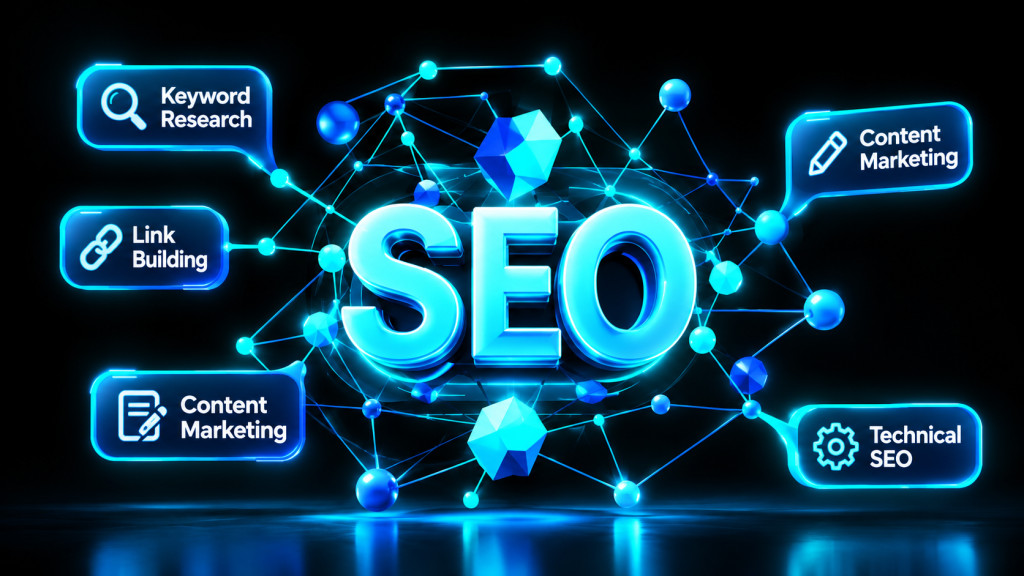
A glowing cyan 3D "SEO" text display surrounded by a network of nodes and callout boxes highlighting search engine optimization steps on a black background
SEO

What Is SEO? A Simple Guide to Search Engine Optimization

If you have a website for your business, getting people to visit it is just as important as having a great website. But how do people actually find your website when they search for products, services, or information on Google?SEO is the process of improving your website so that search engines can understand your content and show your pages to people searching for relevant information. A well-planned SEO strategy can help your website gain more visibility, attract the right audience, build trust, and generate potential customers over time. Whether you run a small local business, an online store, a startup, or a growing company, understanding SEO can help you build a stronger online presence. In this guide, we will explain what SEO is, how it works, why it matters, the different types of SEO, common mistakes, and simple SEO practices you can start using today. What Is SEO? SEO stands for Search Engine Optimization. In simple words, SEO means making your website easier for search engines and people to understand. When someone searches for something on Google, the search engine looks through billions of web pages to find the information that is most relevant to the search. For example, imagine you own a digital marketing agency in India. Someone searches: “digital marketing agency for small businesses” If your website has useful content related to that search, is technically well-structured, provides a good user experience, and follows SEO best practices, your pages may have an opportunity to appear in search results. SEO is not about simply adding keywords to a page. Modern SEO involves many different factors, including content quality, website structure, page experience, relevance, technical performance, links, and user intent. Why Is SEO Important for Your Business? Today, people often use search engines before making a purchase, contacting a company, or choosing a service. Think about your own search behavior. When you need a service, you may search for: “SEO company near me” “best website developer” “social media marketing services” “Google Ads agency” “digital marketing services for startups” Businesses that appear in relevant search results have an opportunity to introduce themselves to potential customers. 1. SEO Improves Online Visibility A beautiful website is not enough if your target audience cannot find it. SEO helps improve your website’s visibility for searches related to your products, services, and industry. The more relevant searches your website can appear for, the more opportunities you have to reach potential visitors. 2. SEO Can Bring Relevant Traffic Not all website traffic is equally valuable. SEO focuses on attracting people who are actively searching for information, products, or services related to your business. For example, someone searching for “SEO services for small businesses” may have a stronger connection to an SEO agency than someone who randomly visits a marketing website. 3. SEO Helps Build Trust People often associate search visibility with credibility, although appearing in search results does not automatically mean a business is trustworthy. Useful content, clear information, positive user experience, transparent business details, and a professional website can all contribute to building trust with visitors. 4. SEO Supports Long-Term Growth Paid advertising can bring traffic while campaigns are running. SEO works differently. When you consistently create useful content and improve your website, your pages can continue attracting organic visitors over time. SEO therefore works best as a long-term strategy rather than a quick shortcut. How Does SEO Work? Search engines use automated systems to discover, understand, and organize web pages. A simplified SEO process looks like this: Crawling → Understanding → Indexing → Ranking → Search Results Crawling Search engines use automated programs, often called crawlers or bots, to discover pages across the web. They can follow links from one page to another and discover new or updated content. Indexing After discovering a page, a search engine may analyze and store information about it in its index. The search engine tries to understand what the page is about and how it relates to different searches. Ranking When someone performs a search, the search engine determines which indexed pages are relevant to that query and orders the results using many different signals. This is why SEO requires more than simply inserting keywords into a page. 1. On-Page SEO On-Page SEO focuses on the content and elements found directly on your website. Important areas include: Page titles Headings Keywords Content quality Meta descriptions Internal links Image alt text URLs Search intent Content structure For example, if you are writing an article about SEO for beginners, your content should clearly explain SEO instead of repeatedly using the phrase “SEO for beginners” throughout every paragraph. The goal is to create content that is useful for the reader while making the topic clear to search engines. 2. Off-Page SEO Off-Page SEO involves activities outside your website that can contribute to your website’s visibility and authority. One important part is link building. When relevant and trustworthy websites link to your content, those links can provide useful signals and referral traffic. Other off-page activities may include: Digital PR Brand mentions Relevant backlinks Business listings Content promotion Relationship building However, quality matters more than simply collecting a large number of links. 3. Technical SEO Technical SEO focuses on the technical foundation of your website. Some important areas include: Website speed Mobile usability Crawlability Indexability Site architecture XML sitemaps HTTPS Structured data Broken links Canonicalization A technically strong website makes it easier for search engines to access and understand your content.   What Are Keywords in SEO? Keywords are words or phrases that people use when searching online. For example: “digital marketing services” could be a keyword related to a digital marketing agency. Keyword research helps businesses understand what their target audience is searching for. But good keyword research goes beyond finding popular phrases. You should consider: Relevance + Search Intent + Competition + Business Value A keyword may have thousands of searches but bring little value to your business. Another keyword may have fewer searches but attract people who are much closer

Scroll to Top