
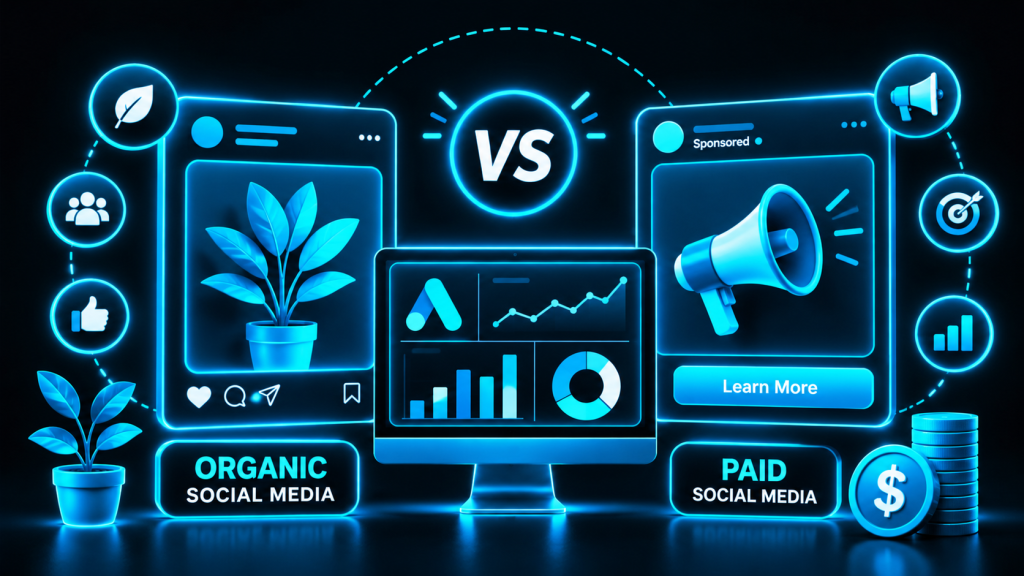
If you are trying to grow your business online, you have probably faced this question at some point:
Should I invest in paid marketing, or should I focus on organic growth?
It’s a fair question.
You have a limited marketing budget, limited time, and a business that needs real results. So naturally, you want to know where your money and effort will have the biggest impact.
Paid marketing can put your business in front of potential customers quickly. Organic marketing can help you build visibility, trust, and long-term traffic without paying for every click.
So, which one is better?
The truth is that there is no single answer.
For some businesses, paid advertising can be the fastest way to generate leads and sales. For others, organic marketing may be the better long-term investment. And for many businesses, the smartest strategy is to use both.
The important thing is understanding what each approach does, when it works best, and how it fits into your business goals.
Let’s break it down in simple terms.
What Is Paid Marketing?
Paid marketing is exactly what it sounds like—you pay a platform to promote your business.
You’ve probably seen paid advertisements every day.
You search for something on Google and see sponsored results at the top.
You scroll through Instagram and come across a product you weren’t actively looking for.
You watch a YouTube video and see an advertisement before the video starts.
These are all forms of paid marketing.
Businesses can use platforms such as Google Ads, Meta Ads, YouTube Ads, LinkedIn Ads, and other advertising networks to reach specific audiences.
The biggest advantage is control.
You can decide how much you want to spend, who you want to target, where your ads should appear, and what action you want people to take.
If your goal is to generate leads quickly or promote a limited-time offer, paid marketing can be extremely useful.
But there is one important thing to remember.
Paid traffic usually stops when you stop paying.
That’s why paid marketing can provide speed, but it doesn’t necessarily build long-term visibility on its own.
What Is Organic Marketing?
Organic marketing is about attracting people without directly paying for every visit, click, or interaction.
It includes strategies such as:
- SEO
- Blog content
- Organic social media
- Educational videos
- Helpful guides
- Email content
- Online communities
- Brand building
- Word-of-mouth marketing
For example, if someone searches Google for a question and finds your blog article in the organic search results, that’s organic traffic.
If someone discovers your Instagram page because your content was shared by another person, that’s organic reach.
If a customer recommends your business to a friend, that’s also organic growth.
Organic marketing usually takes more time.
You need to consistently create useful content, improve your website, build authority, and give people a reason to trust your brand.
But the benefit is that the work you do today can continue bringing results later.
A useful blog post can bring search traffic months after you publish it.
A strong social media post can continue getting shared.
A well-optimized website page can keep attracting potential customers.
That’s the long-term power of organic marketing.
Paid vs Organic: The Basic Difference
The simplest way to understand the difference is this:
Paid marketing buys visibility.
Organic marketing earns visibility.
With paid marketing, you are paying for access to an audience.
With organic marketing, you are building something valuable enough for people to discover, engage with, and share.
Paid marketing can be faster.
Organic marketing can be more sustainable.
Paid marketing gives you immediate control.
Organic marketing can create long-term assets.
Neither is automatically better.
The right choice depends on what your business needs right now.
Why Businesses Choose Paid Marketing
Imagine you have just launched a new business.
Your website is ready.
Your product is ready.
Your sales team is ready.
But hardly anyone knows you exist.
Waiting for organic traffic to grow can take time.
This is where paid advertising can help.
You can create a campaign, define your audience, set a budget, and start reaching potential customers much faster.
This makes paid marketing particularly useful when you need immediate visibility.
For example, paid advertising can work well for:
- New product launches
- Seasonal offers
- Limited-time discounts
- Lead generation
- Event promotion
- Local business promotions
- E-commerce sales
- New service launches
If you have a clear offer and a defined audience, paid marketing can help you get that offer in front of people quickly.
The Biggest Benefits of Paid Marketing
Faster Results
The biggest advantage is speed.
You don’t have to wait months to see whether people are interested in your offer.
Once your campaign is properly set up and approved, your ads can start reaching your target audience.
This doesn’t mean every campaign will be profitable immediately.
You still need the right targeting, creative, offer, landing page, and strategy.
But compared with many organic strategies, paid advertising can produce visibility much faster.
Precise Targeting
Paid platforms allow businesses to target audiences using various available signals.
You can often target based on factors such as location, interests, demographics, search intent, previous interactions, and other platform-specific criteria.
This means you don’t necessarily have to advertise to everyone.
You can focus on the people most likely to need your product or service.
Easy to Measure
Paid advertising gives you plenty of performance data.
You can see impressions, clicks, conversions, costs, and other campaign metrics.
This makes it easier to understand what is working and what isn’t.
Flexible Budget
You can start with a controlled budget and adjust it based on performance.
You can increase spending on campaigns that perform well and reduce spending on campaigns that don’t.
Useful for Testing
Paid campaigns can help you test different headlines, offers, audiences, images, videos, and messages.
This can give you valuable insights into what your customers respond to.
But Paid Marketing Has a Downside
Paid marketing sounds great—and it can be—but it isn’t magic.
One of the biggest disadvantages is cost.
Every click, impression, or conversion may have an associated advertising cost.
And if your campaign isn’t properly optimized, you can spend money without getting meaningful business results.
There’s another issue.
When the advertising stops, the traffic can stop too.
Imagine you spend ₹50,000 on advertising and generate excellent traffic during that month.
The next month, you stop the campaign.
That paid traffic may disappear.
This doesn’t mean paid marketing is bad.
It simply means you shouldn’t think of paid advertising as the only thing your business needs.
Paid campaigns can bring people through the door.
Your website, content, brand, service, and customer experience still need to convince them to stay.
Why Businesses Choose Organic Marketing
Organic marketing takes a different approach.
Instead of paying for visibility, you build assets that attract people naturally.
Think about SEO.
You create a useful article around a topic your audience is searching for.
You optimize it properly.
Over time, the page may begin appearing in search results.
If it ranks well, people can continue discovering it without you paying for every individual click.
The same principle applies to social media.
You consistently create useful content.
People start recognizing your brand.
Some follow you.
Some share your content.
Some eventually become customers.
The process can be slower, but the results can compound over time.
The Biggest Benefits of Organic Marketing
Long-Term Visibility
One of the biggest advantages of organic marketing is longevity.
A useful piece of content doesn’t necessarily stop working after one day.
A blog post, video, guide, or optimized service page can continue attracting people long after it was created.
Builds Trust
People often trust businesses that consistently provide useful information.
If your website answers questions, solves problems, and demonstrates expertise, visitors have more reasons to believe that you know what you’re doing.
This is especially important for service-based businesses.
Reduces Dependence on Ads
If all your traffic comes from paid advertising, your growth depends heavily on your advertising budget.
Organic traffic gives you another source of visitors.
Over time, this can reduce your dependence on paid campaigns.
Creates Valuable Content Assets
Your blog posts, videos, guides, social content, and website pages can continue supporting your business.
You’re not simply buying temporary attention.
You’re building something your business can keep using.
Supports Brand Growth
Organic marketing is not only about traffic.
It can help people become familiar with your brand.
Over time, familiarity can turn into trust, and trust can turn into customers.
But Organic Marketing Takes Time
This is probably the biggest challenge.
If you start SEO today, you shouldn’t expect your website to dominate Google tomorrow.
If you start posting on Instagram today, you shouldn’t expect thousands of followers immediately.
Organic growth usually requires consistency.
You need to publish useful content.
You need to improve your website.
You need to understand what your audience is searching for.
You need to keep learning and adapting.
And sometimes, you can do all of this correctly and still need patience.
That’s why organic marketing is better viewed as a long-term investment rather than a quick fix.
Paid or Organic: Which One Gives Better ROI?
This is where things get interesting.
There is no universal answer.
Your return on investment depends on your industry, audience, offer, competition, pricing, customer lifetime value, conversion rate, and execution.
Suppose you sell a product worth ₹500.
If it costs you ₹700 in advertising to generate one sale, your campaign clearly has a problem.
But suppose you sell a service worth ₹1,00,000.
If you spend ₹5,000 on advertising and generate a customer worth ₹1,00,000, the economics look very different.
The same applies to organic marketing.
Creating an article might take time and money.
But if that article brings relevant traffic for several years, its value can become much larger than the initial investment.
So don’t ask only:
“Which one is cheaper?”
Ask:
“Which one creates more valuable customers for my business?”
That’s a much better question.
When Should You Invest in Paid Marketing?
Paid marketing can make sense when you need results quickly.
Consider investing in paid campaigns when:
You Have a New Product
If you’ve launched something new and want people to know about it, paid advertising can provide fast exposure.
You Need Leads Quickly
Service businesses that need a steady flow of enquiries can use paid campaigns to reach potential customers actively looking for solutions.
You Have a Time-Sensitive Offer
A limited-time sale doesn’t give you months to wait for organic traffic.
Paid advertising can help you get the message out quickly.
You Know Your Target Audience
Paid advertising works better when you understand who your ideal customer is.
You Have a Strong Offer
Advertising can bring people to your business, but the offer still needs to be attractive.
If the product, service, pricing, or value proposition isn’t convincing, increasing your ad budget won’t solve the underlying problem.
When Should You Invest in Organic Marketing?
Organic marketing is particularly valuable when you’re thinking about long-term growth.
Consider focusing more on organic strategies when:
You Want Sustainable Traffic
If you want people to keep discovering your website without paying for every visit, SEO and content marketing can be valuable.
You’re Building a Brand
Organic content gives you more opportunities to communicate your personality, knowledge, values, and expertise.
You Have Useful Knowledge to Share
If your business can answer customer questions or solve problems through content, organic marketing can become a powerful growth channel.
You’re Playing the Long Game
Organic marketing is most valuable when you’re willing to invest consistently rather than expecting instant results.
What If You Have a Small Marketing Budget?
This is where many business owners get stuck.
They think:
“I can’t afford to do both.”
That’s understandable.
If your budget is limited, don’t try to do everything at once.
Start by identifying your biggest business need.
If you need customers immediately, you may want to allocate more toward paid marketing.
If you already have enough short-term business but want to build a stronger source of long-term traffic, you may want to prioritize SEO and content.
You can also start small with both.
For example, you might use a controlled paid budget to generate immediate opportunities while consistently investing time in organic content.
The exact percentage doesn’t have to be the same for every business.
Your allocation should change as your business changes.
Why the Best Strategy Is Often Both
Here’s something many businesses eventually realize:
Paid and organic marketing work better together than they do separately.
Imagine you run a digital marketing agency.
You use Google Ads to bring potential clients to your website.
At the same time, your website contains useful SEO articles explaining digital marketing, SEO, paid advertising, and social media.
A potential client clicks your advertisement.
They visit your service page.
Then they discover your blog.
They read several articles.
They see your case studies.
They check your social media.
Now they’re not just seeing an advertisement.
They’re getting a complete picture of your brand.
This is where paid and organic marketing can reinforce each other.
Paid marketing brings attention.
Organic marketing helps build trust.
Your website turns that attention into action.
Together, they create a stronger customer journey.
A Simple Paid + Organic Strategy
You don’t need a complicated marketing system to start.
A simple strategy could look like this:
Step 1: Build Your Organic Foundation
Make sure your website is useful, mobile-friendly, fast, and easy to understand.
Create important service and product pages.
Start publishing useful content around the questions your customers ask.
Step 2: Identify High-Value Keywords
Find the search terms that potential customers actually use.
Create content around informational searches and optimize commercial pages around high-intent searches.
Step 3: Run Focused Paid Campaigns
Use paid advertising for products, services, keywords, locations, or offers where you want faster visibility.
Step 4: Retarget Interested Visitors
People who visit your website but don’t convert can potentially be reached again through appropriate remarketing campaigns.
Step 5: Measure Everything
Look beyond traffic.
Track leads, sales, conversions, cost per acquisition, and revenue.
Step 6: Invest More in What Works
If a particular organic page consistently brings qualified visitors, improve it.
If a paid campaign consistently generates good customers, consider scaling it carefully.
This creates a cycle of:
Test → Learn → Improve → Grow
Paid Marketing Can Help Your Organic Strategy Too
An interesting thing about paid and organic marketing is that insights from one can improve the other.
Suppose you run a Google Ads campaign and discover that customers respond strongly to a particular keyword.
That keyword could inspire a new SEO article or service page.
Or perhaps a particular advertisement headline generates excellent engagement.
You can use the same customer language in your website copy.
Similarly, if one of your organic blog posts receives a lot of traffic and engagement, you could consider promoting it through paid advertising to reach a wider audience.
So the relationship doesn’t have to be one-way.
Your paid campaigns can teach you about your customers.
Your organic content can show you what your audience cares about.
Both can make the other stronger.
Common Mistakes Businesses Make
Choosing One Strategy Just Because It’s Popular
What works for another business may not work for yours.
A strategy should be based on your audience, industry, budget, and goals.
Expecting Instant SEO Results
SEO is a long-term process.
If you’re investing in organic marketing, give it enough time to develop.
Running Ads Without a Clear Goal
Don’t advertise simply because your competitors are advertising.
Know what you want your campaign to achieve.
Sending Paid Traffic to a Weak Website
If your website is confusing or difficult to use, paid traffic won’t magically fix the problem.
Improve the customer experience first.
Stopping Organic Content Too Early
Organic growth requires consistency.
Publishing three articles and then disappearing for six months is unlikely to create strong momentum.
Measuring the Wrong Numbers
Likes and clicks can be useful, but they aren’t always the final goal.
What matters most is whether your marketing contributes to actual business outcomes.
So, Where Should You Invest?
If you’re still wondering whether you should choose paid or organic marketing, start with a simpler question:
What does my business need right now?
If you need faster visibility, immediate traffic, quick lead generation, or promotion of a time-sensitive offer, paid marketing may deserve more attention.
If you want long-term traffic, stronger search visibility, authority, trust, and sustainable brand growth, organic marketing should be part of your strategy.
If you want both short-term opportunities and long-term growth, combine them.
For most growing businesses, the answer isn’t:
Paid OR Organic.
It’s:
Paid AND Organic—but with the right balance.
Conclusion
So, paid or organic marketing: where should you invest?
The answer depends on what your business needs right now.
Paid marketing can help you reach potential customers quickly, test offers, and generate traffic through advertisements. Organic marketing can help you build long-term visibility, share expertise, and develop trust with your audience.
Neither strategy guarantees success, and both require planning, consistent effort, and performance measurement.
For many businesses, the strongest approach is to use paid marketing for focused short-term goals while building organic marketing for sustainable growth. Start with a realistic budget, track the results that matter, and invest more in the activities that attract the right customers.
With a clear plan and consistent improvement, your marketing can become a valuable part of your business growth.
Want to grow your business online? Explore GrowOrbital’s digital marketing services and find a strategy that fits your business goals.
Frequently Asked Questions (FAQs)
1. Is paid marketing better than organic marketing?
Neither is always better. Paid marketing can help generate traffic quickly, while organic marketing can build long-term visibility. The right choice depends on your budget, goals, audience, and timeline.
2. Is organic marketing free?
Organic marketing does not require payment for each advertisement or click, but it still involves costs such as content creation, SEO, website maintenance, and staff time.
3. How long does organic marketing take to work?
The timeline varies by channel and competition. SEO often takes several months to show meaningful progress, while some social media content may attract attention sooner. Results are not guaranteed.
4. Can a small business use both paid and organic marketing?
Yes. A small business can test focused paid campaigns while building its website, improving SEO, and publishing helpful content. The balance should fit its budget and goals.
5. Which is better for generating leads?
Paid marketing may help you reach potential customers quickly, while organic marketing can attract people who are researching a problem or solution. Lead quality depends on targeting, content, the offer, and the conversion process.
6. Should I stop paid ads once organic traffic increases?
Not necessarily. If paid ads generate profitable customers, they may still be worth running. Compare the costs and results of each channel before changing your budget.
7. What should I measure in paid and organic marketing?
For paid marketing, track spending, conversions, cost per lead, customer acquisition cost, and return on ad spend where applicable. For organic marketing, track relevant traffic, search visibility, engagement, leads, and conversions.