
Have you ever searched for something on Google, such as the best restaurant near you, digital marketing services, or tips to grow your business online? Within seconds, Google shows thousands of results related to your search. But have you ever wondered why some websites appear at the top while others remain on the second, third, or even tenth page?
The answer is SEO, which stands for Search Engine Optimization.
SEO helps websites improve their visibility on search engines like Google. When a website follows good SEO practices, search engines can better understand its content and determine when it may be useful to people searching for related information, products, or services.
For businesses, SEO is an important way to reach potential customers, attract relevant website visitors, build trust, and grow online. Whether you run a small local business, an online store, or a digital marketing agency, understanding how SEO works can help you build a stronger online presence.
In this guide, we will explain how SEO works, how Google ranks websites, the main types of SEO, and the steps you can take to improve your website’s search visibility.
What Is SEO?
SEO, or Search Engine Optimization, is the process of improving a website so that it can appear more prominently in organic search results.
Organic search results are unpaid listings that appear when someone searches for information on a search engine. Unlike paid advertisements, you do not pay Google for every click you receive from organic results.
The main goal of SEO is to help search engines understand your website and help users find relevant, useful content.
For example, imagine you own a dental clinic in Delhi. When someone searches for “best dentist in Delhi,” you want your clinic’s website to appear among the relevant search results. SEO can help improve your chances of reaching people who are actively looking for dental services.
SEO involves several activities, including:
Finding relevant keywords that people search for.
Creating helpful and informative website content.
Improving website speed and mobile usability.
Optimizing page titles, headings, URLs, and images.
Building your website’s reputation through relevant links and mentions.
Improving local search visibility when your business serves a particular area.
Checking website performance and making improvements over time.
SEO is not about tricking search engines. It is about creating a website that is useful for people and easy for search engines to discover, understand, and access.
How Does SEO Work?
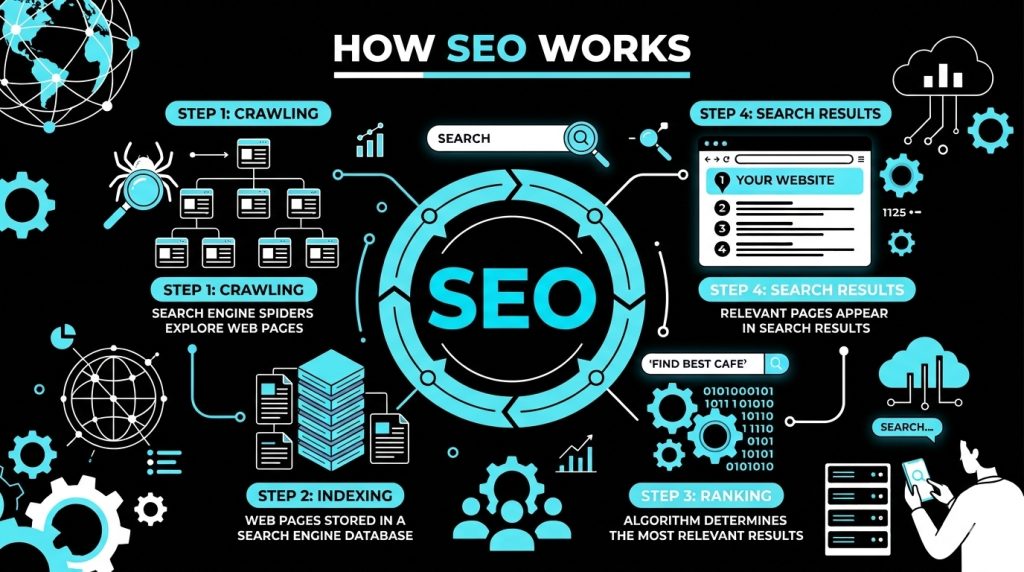
SEO works through a combination of activities that help search engines discover your website, understand its content, and decide which pages are most relevant to a user’s search.
Google generally uses three important stages: crawling, indexing, and serving search results. SEO can influence how effectively your pages perform throughout this process, although no SEO technique guarantees a particular ranking.
Let’s understand each stage in simple language.
1. Crawling: Discovering Your Website
Crawling is the process through which search engines discover and access web pages.
Search engines use automated programs called crawlers or bots to explore websites. Google’s primary web crawler is known as Googlebot.
Googlebot can discover pages through links from other pages, sitemaps, and previously known URLs. It then attempts to access those pages and understand their content.
For example, imagine you publish a blog titled “Benefits of Digital Marketing for Small Businesses.” If Google discovers the URL and can access the page, its crawler may visit it to examine the content.
To make crawling easier, you should:
Create a clear website structure.
Link important pages together.
Submit an XML sitemap through Google Search Console.
Avoid accidentally blocking important pages in robots.txt.
Fix broken internal links.
Make sure important content is accessible to search engine crawlers.
If Google cannot discover or access an important page, that page may struggle to appear in search results.
2. Indexing: Understanding and Storing Your Content
After crawling a page, Google may analyze its content and decide whether to include it in its search index.
Indexing is similar to organizing information in a huge digital library. Google processes information such as page text, images, titles, and other available signals to understand what a page is about.
For example, if your page explains “What Is SEO?” and contains useful information about keywords, backlinks, and technical SEO, Google may identify it as a page related to search engine optimization.
However, crawling does not guarantee indexing. Google may choose not to index a page for various reasons, including duplicate content, limited usefulness, technical problems, or other quality-related considerations.
You can improve your chances of proper indexing by:
Publishing original and useful content.
Using appropriate page titles and headings.
Avoiding unnecessary duplicate pages.
Fixing incorrect noindex directives.
Maintaining a logical internal linking structure.
Checking indexing reports in Google Search Console.
Remember that Google decides which pages to index. Submitting a sitemap or requesting indexing does not guarantee that a page will be included.
3. Ranking: Showing Relevant Search Results
When someone enters a search query, Google attempts to display results that are relevant and useful for that particular search.
This is where ranking becomes important.
Google uses many automated systems and signals to evaluate pages. These systems aim to understand the meaning of a search, the relevance of available content, the quality and usability of pages, and other factors that help deliver useful results.
For example, when someone searches for “how to improve website speed,” Google is likely to favor pages that directly explain website speed optimization rather than pages that only discuss general business growth.
To improve your website’s ranking potential, focus on:
Understanding what your target audience wants to know.
Publishing helpful, accurate, and original content.
Using relevant keywords naturally.
Improving page experience and mobile usability.
Making important information easy to find.
Earning relevant, trustworthy backlinks.
Keeping content accurate and up to date when necessary.
There is no guaranteed method to reach the first position on Google. Rankings depend on the query, competition, relevance, quality, and many other factors.
The Main Types of SEO
SEO includes different areas of optimization. Each area helps improve a different part of your website’s search performance.
1. On-Page SEO
On-page SEO involves optimizing the content and elements of individual web pages so that users and search engines can understand them more easily.
It focuses on the information visitors see and the page elements that describe that information.
Important on-page SEO activities include:
Keyword research and placement: Identify the words and phrases your target audience uses and include them naturally in relevant content.
Title tags: Write clear, descriptive page titles that accurately explain what each page offers.
Meta descriptions: Create useful summaries that may encourage people to click your search result. Meta descriptions are not a direct Google ranking factor, but they can help communicate what a page contains.
Headings: Use a clear heading structure with an informative H1 and meaningful subheadings.
Internal links: Link related pages together to help visitors discover more information and help search engines understand the relationship between your pages.
Image optimization: Use descriptive image filenames and appropriate alternative text for meaningful images.
For example, if you publish a page about SEO services, its title might be “SEO Services to Improve Your Website Visibility.” The page should then explain the services, process, benefits, and relevant customer questions.
The goal is to make the page helpful and clear rather than repeating the same keyword unnecessarily.
2. Off-Page SEO
Off-page SEO refers to activities outside your website that can help build its reputation and authority.
One well-known part of off-page SEO is link building. A backlink is a link from another website to your website.
For example, if a reputable business publication links to your guide on digital marketing, that link may help people discover your content and can contribute to your website’s authority signals.
However, not all backlinks have equal value. Links that are relevant and naturally earned are generally more useful than large numbers of low-quality or artificial links.
Common off-page SEO activities include:
Creating content that other websites want to reference.
Building relationships with relevant publishers and businesses.
Contributing useful expert insights to industry publications.
Earning legitimate brand mentions.
Maintaining accurate business information across relevant platforms.
Encouraging genuine customer reviews for local businesses.
Avoid buying manipulative links or participating in link schemes intended to influence rankings. Such practices can violate Google’s spam policies.
Off-page SEO is about building genuine trust and recognition rather than simply collecting as many links as possible.
3. Technical SEO
Technical SEO focuses on the technical aspects of a website that help search engines access, understand, and process its pages.
Even excellent content may struggle to perform if search engines cannot access it properly or if the website has serious technical problems.
Important technical SEO activities include:
Website speed: Improve loading performance by optimizing images, reducing unnecessary scripts, and using efficient hosting.
Mobile usability: Make sure the website works well on smartphones, tablets, and desktop computers.
HTTPS security: Use a secure HTTPS connection to protect data exchanged between the website and its visitors.
XML sitemap: Provide search engines with a useful list of important URLs.
Robots.txt: Configure crawler access carefully so that important pages are not accidentally blocked.
Canonical tags: Help indicate the preferred version of a page when similar or duplicate URLs exist.
Structured data: Use appropriate structured data to help search engines understand certain types of content. Eligible pages may qualify for enhanced search appearances, but these are not guaranteed.
Broken links and redirects: Fix unnecessary errors and ensure that redirected pages lead to the correct destinations.
Technical SEO creates a strong foundation for your content and other SEO activities.
4. Local SEO
Local SEO helps businesses improve their visibility in searches related to a particular location.
It is especially useful for businesses such as dental clinics, restaurants, salons, repair services, and local marketing agencies.
For example, a person searching for “dentist near me” may see a map with nearby dental clinics, followed by other relevant results.
To improve local SEO, businesses should:
Create and maintain a Google Business Profile where eligible.
Use accurate business names, addresses, phone numbers, and opening hours.
Select appropriate business categories.
Add useful photos and service information.
Encourage genuine customer reviews.
Respond professionally to customer feedback.
Create useful location-specific website content where appropriate.
Local rankings are influenced by factors such as relevance, distance, and prominence. Businesses cannot directly control every factor, and a well-optimized profile does not guarantee a particular position.
Local SEO helps nearby customers discover businesses when they are actively looking for relevant products or services.
How Keywords Help SEO Work
Keywords are words and phrases that people enter into search engines when looking for information, products, or services.
Keyword research helps you understand what your audience is searching for and what type of content could satisfy their needs.
For example, a digital marketing agency may target keywords such as:
What is SEO?
How SEO works.
SEO services for small businesses.
Benefits of search engine optimization.
Local SEO for dental clinics.
Different keywords reflect different search intentions.
Someone searching for “what is SEO” probably wants an explanation. Someone searching for “SEO agency near me” may be looking for a service provider.
Understanding search intent helps you create the right type of page for the right audience.
There are four common types of search intent:
Informational intent: The user wants to learn something, such as how SEO works.
Navigational intent: The user wants to find a specific website or brand.
Commercial investigation: The user is comparing options before making a decision.
Transactional intent: The user is ready to take action, such as purchasing a service or booking an appointment.
Choose keywords that are relevant to your business and create content that genuinely answers the searcher’s question. Do not force keywords into every sentence.
Why Is Quality Content Important for SEO?
Content is one of the most important parts of an effective SEO strategy because it helps answer users’ questions and provides information about your products, services, or expertise.
Search engines aim to show results that are useful and relevant to the search query. Therefore, publishing content that clearly satisfies the user’s needs can help your website compete for relevant searches.
Good SEO content should be:
Helpful and easy to understand.
Accurate and supported by reliable information.
Original rather than copied from other websites.
Organized with meaningful headings.
Written for the intended audience.
Updated when the information becomes outdated.
Supported by relevant examples, images, or explanations when useful.
For example, if you are writing about “How SEO Works,” simply repeating the keyword many times will not make the article valuable.
Instead, explain crawling, indexing, ranking, keyword research, on-page SEO, off-page SEO, technical SEO, and performance measurement in a way that readers can understand.
You should also consider who created the content, whether the information is trustworthy, and whether it offers something useful beyond what readers can find elsewhere.
You do not need to publish content every day. Focus on creating useful pages that serve a clear purpose.
How Website Experience Affects SEO
A good website experience makes it easier for visitors to find information and complete tasks.
If a website loads slowly, displays poorly on mobile devices, or has confusing navigation, visitors may find it difficult to use.
Google considers several page experience and usability-related signals, including aspects of loading performance, responsiveness, and visual stability. However, good page experience alone does not guarantee high rankings.
To improve the experience, you should:
Make navigation simple and logical.
Use readable fonts and appropriate spacing.
Make buttons and links easy to use.
Optimize large images.
Avoid intrusive pop-ups that block important content.
Ensure forms work correctly.
Make important pages accessible on mobile devices.
Use clear calls to action where appropriate.
A well-designed website helps visitors understand your business and makes it easier for them to contact you, request a quote, or explore your services.
SEO should therefore work together with website design, content, and conversion optimization.
How to Measure SEO Performance
SEO is an ongoing process. After optimizing your website, you need to measure its performance to understand what is working and what needs improvement.
Two useful tools are Google Search Console and Google Analytics.
Google Search Console
Google Search Console helps website owners understand how their websites perform in Google Search.
You can use it to review:
Search queries that generate impressions.
Clicks from Google Search.
Click-through rate.
Average search position.
Indexing issues.
Sitemap status.
Certain technical and search appearance reports.
For example, if a page receives many impressions but few clicks, you can review whether its title and description accurately communicate its value to searchers.
Google Analytics
Google Analytics helps you understand what people do after visiting your website.
Depending on your setup, you can measure:
Website traffic.
Landing page performance.
Engagement.
Traffic sources.
Important events and conversions.
Contact form submissions or other business actions.
For example, a dental clinic may measure how many website visitors submit an appointment request after arriving through organic search.
Do not judge SEO only by rankings. Also consider relevant organic traffic, engagement, qualified leads, inquiries, and business results.
How Long Does SEO Take to Work?
SEO usually takes time because search engines need to discover, process, and evaluate pages, while websites also need time to build useful content and reputation.
Some technical improvements may show benefits relatively quickly, while competitive keywords can require months of consistent work.
The timeline depends on several factors, including:
Your website’s current condition.
The competition for your target keywords.
The quality and relevance of your content.
The technical health of your website.
Your website’s existing reputation.
How consistently you implement improvements.
There is no fixed timeline or guaranteed ranking.
Google advises that SEO changes can take time to produce noticeable effects. Some changes may be reflected relatively quickly, while others may take several months.
The best approach is to follow a consistent strategy, monitor performance, and improve your website based on real data.
Common SEO Mistakes to Avoid
Many website owners make mistakes that can limit their SEO performance.
Here are some common problems to avoid:
1. Keyword stuffing: Repeating keywords unnaturally makes content difficult to read and may violate spam policies when used manipulatively.
2. Copying content: Publishing copied or unoriginal material does not provide a strong reason for users to choose your page.
3. Ignoring mobile users: A website that is difficult to use on mobile devices can create a poor experience.
4. Neglecting technical issues: Broken links, accidental crawling restrictions, and incorrect indexing settings can prevent important pages from performing properly.
5. Buying spammy backlinks: Manipulative link schemes can violate Google’s guidelines and may expose your website to ranking problems.
6. Publishing content without a purpose: Every important page should serve a clear audience need or business goal.
7. Expecting instant results: SEO requires testing, monitoring, and continued improvement.
8. Ignoring performance data: Without reviewing search and website analytics, you may miss opportunities to improve your strategy.
Avoiding these mistakes helps you build a more sustainable SEO foundation.
Step-by-Step SEO Strategy for Beginners
If you are new to SEO, follow these practical steps to get started.
Step 1: Set your goal. Decide whether you want more organic visitors, local customers, service inquiries, online sales, or brand awareness.
Step 2: Research your audience. Understand what your potential customers need and what questions they ask online.
Step 3: Find relevant keywords. Identify useful search terms that match your services and the audience’s intent.
Step 4: Check your website. Review indexing, page speed, mobile usability, navigation, broken links, and other technical issues.
Step 5: Optimize important pages. Improve titles, headings, page content, images, internal links, and calls to action.
Step 6: Publish helpful content. Create blogs, service pages, guides, and FAQs that answer real customer questions.
Step 7: Build your online reputation. Earn relevant backlinks, develop genuine business relationships, and maintain accurate local listings when applicable.
Step 8: Track results. Use Google Search Console and Google Analytics to review performance and important business outcomes.
Step 9: Improve continuously. Update outdated information, fix technical problems, and improve pages based on what your data shows.
Following these steps gives you a structured way to improve your website instead of relying on random SEO activities.
Conclusion
SEO is an important part of building a successful online presence. It helps search engines understand your website, connects your content with relevant searches, and makes it easier for potential customers to discover your business.
From keyword research and content creation to technical improvements and link building, every part of SEO plays a role in improving your website’s overall search performance.
However, SEO is not about finding shortcuts or trying to trick search engines. It is about understanding your audience, providing useful information, and creating a website that offers a great experience.
If you want your business to grow online, start with the basics. Optimize your important pages, publish helpful content, improve your website performance, and track your progress using reliable SEO tools.
At GrowOrbital, we believe that every business deserves a strong online presence. With the right SEO strategy, your website can reach the right audience, build brand awareness, and create more opportunities for long-term business growth.
Start working on your SEO today and take the next step toward growing your business online.
Frequently Asked Questions (FAQs)
1. What is SEO in simple words?
SEO stands for Search Engine Optimization. It is the process of improving your website so that it can appear more prominently in search engine results and attract relevant organic traffic.
2. How does SEO work step by step?
SEO generally involves keyword research, creating helpful content, optimizing website pages, improving technical performance, building quality backlinks, and monitoring search performance.
3. How long does SEO take to show results?
SEO can take several months to show noticeable results. The timeline depends on your website, competition, content quality, and the SEO work being performed.
4. Is SEO free or paid?
Organic SEO does not require paying Google for every click. However, you may need to invest in SEO tools, professional services, content creation, and website improvements.
5. What are the three main types of SEO?
The three main types are On-Page SEO, Off-Page SEO, and Technical SEO. Together, they help improve your website’s content, authority, and technical performance.
6. Can a new website rank on Google?
Yes. A new website can appear in Google search results if its pages are accessible, indexed, relevant, and useful. However, gaining strong rankings can take time.
7. Why is keyword research important for SEO?
Keyword research helps you understand what your target audience searches for. It allows you to create relevant content that answers their questions and matches their search intent.
8. Which SEO tools are best for beginners?
Google Search Console, Google Analytics 4, and Google Keyword Planner are useful starting points. They help you monitor performance, understand visitors, and research keywords.
9. What is the difference between SEO and Google Ads?
SEO focuses on improving organic visibility in search results, while Google Ads allows businesses to pay for advertising placements. SEO can support long-term organic growth, whereas Google Ads can provide paid visibility while campaigns are running.
10. Why is SEO important for small businesses?
SEO helps small businesses reach people searching for their products or services. It can increase online visibility, attract relevant visitors, build brand awareness, and generate potential customers.