September 27, 2026

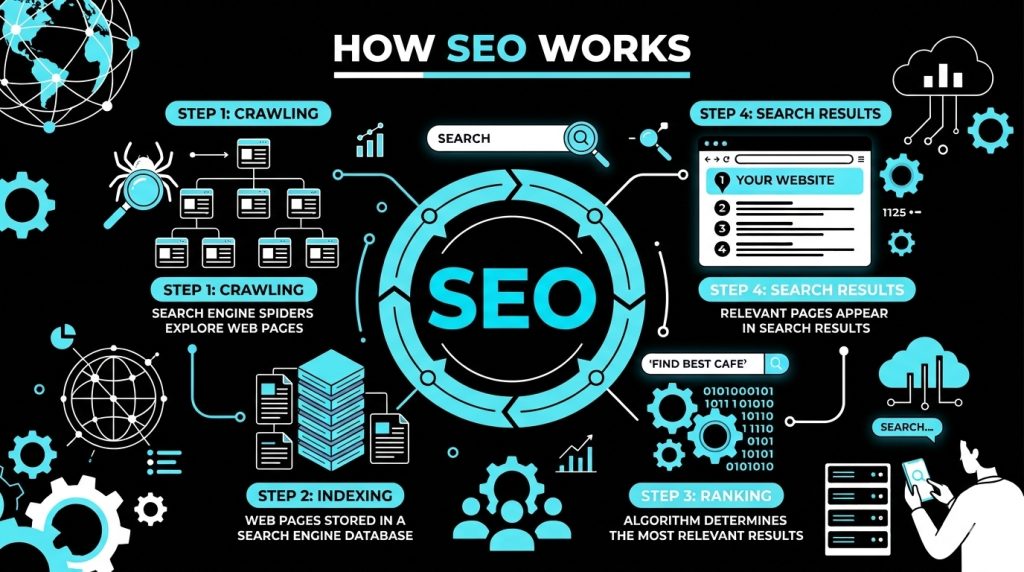
An educational infographic titled "HOW SEO WORKS" outlining a four-step process—Crawling, Indexing, Ranking, and Search Results—illustrated with cyan text, icons, and diagrams on a black background.
SEO

How SEO Works

Have you ever searched for something on Google, such as the best restaurant near you, digital marketing services, or tips to grow your business online? Within seconds, Google shows thousands of results related to your search. But have you ever wondered why some websites appear at the top while others remain on the second, third, or even tenth page? The answer is SEO, which stands for Search Engine Optimization. SEO helps websites improve their visibility on search engines like Google. When a website follows good SEO practices, search engines can better understand its content and determine when it may be useful to people searching for related information, products, or services. For businesses, SEO is an important way to reach potential customers, attract relevant website visitors, build trust, and grow online. Whether you run a small local business, an online store, or a digital marketing agency, understanding how SEO works can help you build a stronger online presence. In this guide, we will explain how SEO works, how Google ranks websites, the main types of SEO, and the steps you can take to improve your website’s search visibility. What Is SEO? SEO, or Search Engine Optimization, is the process of improving a website so that it can appear more prominently in organic search results. Organic search results are unpaid listings that appear when someone searches for information on a search engine. Unlike paid advertisements, you do not pay Google for every click you receive from organic results. The main goal of SEO is to help search engines understand your website and help users find relevant, useful content. For example, imagine you own a dental clinic in Delhi. When someone searches for “best dentist in Delhi,” you want your clinic’s website to appear among the relevant search results. SEO can help improve your chances of reaching people who are actively looking for dental services. SEO involves several activities, including: Finding relevant keywords that people search for. Creating helpful and informative website content. Improving website speed and mobile usability. Optimizing page titles, headings, URLs, and images. Building your website’s reputation through relevant links and mentions. Improving local search visibility when your business serves a particular area. Checking website performance and making improvements over time. SEO is not about tricking search engines. It is about creating a website that is useful for people and easy for search engines to discover, understand, and access. How Does SEO Work? SEO works through a combination of activities that help search engines discover your website, understand its content, and decide which pages are most relevant to a user’s search. Google generally uses three important stages: crawling, indexing, and serving search results. SEO can influence how effectively your pages perform throughout this process, although no SEO technique guarantees a particular ranking. Let’s understand each stage in simple language. 1. Crawling: Discovering Your Website Crawling is the process through which search engines discover and access web pages. Search engines use automated programs called crawlers or bots to explore websites. Google’s primary web crawler is known as Googlebot. Googlebot can discover pages through links from other pages, sitemaps, and previously known URLs. It then attempts to access those pages and understand their content. For example, imagine you publish a blog titled “Benefits of Digital Marketing for Small Businesses.” If Google discovers the URL and can access the page, its crawler may visit it to examine the content. To make crawling easier, you should: Create a clear website structure. Link important pages together. Submit an XML sitemap through Google Search Console. Avoid accidentally blocking important pages in robots.txt. Fix broken internal links. Make sure important content is accessible to search engine crawlers. If Google cannot discover or access an important page, that page may struggle to appear in search results. 2. Indexing: Understanding and Storing Your Content After crawling a page, Google may analyze its content and decide whether to include it in its search index. Indexing is similar to organizing information in a huge digital library. Google processes information such as page text, images, titles, and other available signals to understand what a page is about. For example, if your page explains “What Is SEO?” and contains useful information about keywords, backlinks, and technical SEO, Google may identify it as a page related to search engine optimization. However, crawling does not guarantee indexing. Google may choose not to index a page for various reasons, including duplicate content, limited usefulness, technical problems, or other quality-related considerations. You can improve your chances of proper indexing by: Publishing original and useful content. Using appropriate page titles and headings. Avoiding unnecessary duplicate pages. Fixing incorrect noindex directives. Maintaining a logical internal linking structure. Checking indexing reports in Google Search Console. Remember that Google decides which pages to index. Submitting a sitemap or requesting indexing does not guarantee that a page will be included. 3. Ranking: Showing Relevant Search Results When someone enters a search query, Google attempts to display results that are relevant and useful for that particular search. This is where ranking becomes important. Google uses many automated systems and signals to evaluate pages. These systems aim to understand the meaning of a search, the relevance of available content, the quality and usability of pages, and other factors that help deliver useful results. For example, when someone searches for “how to improve website speed,” Google is likely to favor pages that directly explain website speed optimization rather than pages that only discuss general business growth. To improve your website’s ranking potential, focus on: Understanding what your target audience wants to know. Publishing helpful, accurate, and original content. Using relevant keywords naturally. Improving page experience and mobile usability. Making important information easy to find. Earning relevant, trustworthy backlinks. Keeping content accurate and up to date when necessary. There is no guaranteed method to reach the first position on Google. Rankings depend on the query, competition, relevance, quality, and many other factors. The Main Types of SEO SEO includes different areas of optimization. Each area
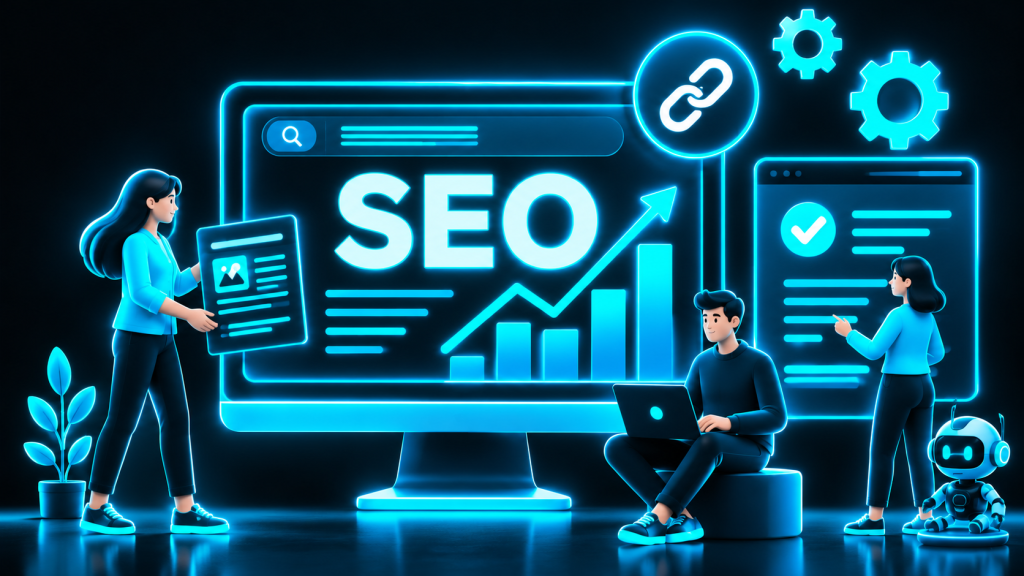
A glowing cyan graphic for "SEO" optimization featuring a large monitor with a growth chart, surrounded by digital marketers, link icons, and a small robot on a black background.
SEO

SEO Growth Strategy

Every business wants more customers, more website visitors, and better growth. Today, many people search on Google before buying a product, choosing a service, or contacting a company. If your website does not appear when potential customers search for something related to your business, you may miss valuable opportunities. This is where an SEO growth strategy becomes important. SEO stands for Search Engine Optimization. It helps your website become more visible in search engines and makes it easier for people to discover your business online. However, successful SEO is not just about getting your website to the first page of Google. It is about attracting the right people, giving them useful information, building trust, and turning website visitors into potential customers. An effective SEO growth strategy gives your business a clear plan for achieving these goals. Instead of making random changes to your website, you focus on the activities that can improve visibility, attract relevant traffic, and support long-term business growth. For example, imagine you run a digital marketing agency. You want business owners to find your website when they search for SEO services, website development, or digital marketing solutions. By targeting relevant keywords, publishing helpful content, improving your website, and building your online reputation, you can increase your chances of reaching those people. In this guide, we will explain what an SEO growth strategy is, why it matters, and how you can create a practical strategy to grow your website organically. What Is an SEO Growth Strategy? An SEO growth strategy is a planned approach to improving your website’s visibility in organic search results and attracting visitors who are genuinely interested in your products or services. It combines different SEO activities, such as keyword research, content creation, technical improvements, on-page optimization, link building, and performance tracking. The main purpose is not simply to increase the number of visitors to your website. It is to attract people who may become customers, subscribers, or valuable leads. For example, a website might receive thousands of visitors every month, but if those visitors are not interested in its services, the traffic may not produce meaningful results. A good SEO strategy focuses on relevant traffic that supports your business goals. An effective SEO growth strategy usually includes: Understanding your target audience. Researching relevant keywords. Studying competitors and search intent. Creating helpful website content. Improving technical SEO. Optimizing existing pages. Building a trustworthy online presence. Measuring traffic, leads, and conversions. Improving the strategy based on actual performance. SEO growth does not happen overnight. It requires consistent effort, patience, and regular improvements. When done properly, it can help businesses build a stronger online presence over time. Why Is an SEO Growth Strategy Important? Without a clear plan, businesses often publish content without understanding what their audience needs or which keywords they should target. They may also spend time optimizing pages that do not support their main business goals. An SEO growth strategy helps you use your time and resources more effectively. 1. It Helps People Discover Your Business When your website appears for relevant search queries, potential customers have more opportunities to discover your business. For example, if you provide website development services, you may want your website to appear when people search for terms such as “website development services” or “website developer for small business.” By creating useful pages around relevant topics, you can improve your chances of reaching people who are already looking for the services you offer. 2. It Brings Relevant Website Traffic Not every website visitor is a potential customer. The goal is to attract people who are interested in your content, products, or services. Keyword research and search intent analysis help you understand what people want when they search online. For example, someone searching for “what is SEO” may want to learn about search engine optimization. Someone searching for “SEO services for my business” may be comparing service providers. Creating the right content for each type of search can help you attract visitors who are more relevant to your business. 3. It Builds Trust and Credibility People are more likely to trust a business that provides clear information, answers their questions, and offers a helpful website experience. Publishing useful blogs, detailed service pages, case studies, and practical guides can demonstrate your knowledge and help visitors understand what your business offers. SEO does not automatically make a business trustworthy. However, a well-organized website with accurate information and a consistent online presence can help build confidence. 4. It Supports Long-Term Growth Paid advertising can bring traffic while campaigns are running. SEO can help your pages continue attracting organic visitors after they have earned visibility, although rankings and traffic can change over time. For example, a useful blog about website development may continue receiving search traffic long after its publication date if it remains relevant and performs well. This makes SEO a valuable part of a long-term digital marketing strategy. 5. It Can Help Generate More Leads Website traffic becomes more valuable when visitors take meaningful actions. These actions may include submitting a contact form, calling your business, booking an appointment, requesting a quotation, or purchasing a product. By combining SEO with useful content and clear calls to action, you can make it easier for potential customers to take the next step. Step 1: Set Clear SEO Growth Goals Before starting SEO activities, decide what you want to achieve. Without clear goals, it becomes difficult to measure whether your strategy is working. Different businesses have different objectives. An online store may want to increase organic product sales. A dental clinic may want more appointment requests. A digital marketing agency may want more service inquiries. Start by asking yourself three simple questions: What do I want my website to achieve? Who do I want to reach? What action should visitors take after arriving on my website? Your goals should be connected to actual business outcomes. For example, GrowOrbital may focus on improving organic visibility for its SEO, social media marketing, Google Ads, email marketing,

Scroll to Top